


A4 semaphore
From our guest: Florence Paterson
The Paris suburbs, May 2026.
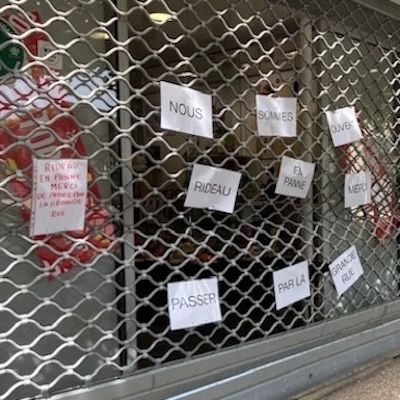
Behind the metal curtain, the glass doors are wide open, the lights are on. I sense some activity going on. A dozen A4 sheets in plastic sleeves are scattered across the metal curtain, the crease in the middle of which seems to grimace—a grimace of malfunction. This setup tells a story. That of an iron curtain that stubbornly refuses to rise, then slumps under the efforts of the shopkeepers, signaling with this decisive movement that it’s time to call a maintenance technician. The problem is less about opening the store than about letting passersby know that they can still go inside, browse, and buy the items for sale. This temporarily blocked entrance opens onto the town hall square, and it is the first view passersby have of the store when coming from the train station. Initially, the shopkeepers hung a sign on the storefront written in large red letters: “Curtain out of order”, then, the important message: “Please enter via Main Street.” The store remains accessible via the adjacent street. One can imagine the shopkeepers, perhaps surrounded by salespeople, stepping back to assess the effect. Maybe a discussion even came up: “It’s not visible enough; everyone’s going to think we’re closed.” Then comes this idea that I like to call “semaphoric” (from the Greek σ η ̃ μ α “sign” and φ ο ρ ο ́ ς “that conveys,” according to the Trésor de la Langue Française). If a single poster with red lettering proves ineffective, the signal must be reverberated to be sufficiently amplified and seen. The breakdown and the access take turns on this swarm of A4 posters placed in the passerby’s field of vision, forcing the gaze to shift from the previous one to the next to decipher the message. It is the whole ensemble, and the non-linear placement of all the words, each occupying a single sheet, that creates the dynamic, a movement that catches the eye.